
Clevor vs Ledger Stax: Smart Card Wallets Compared
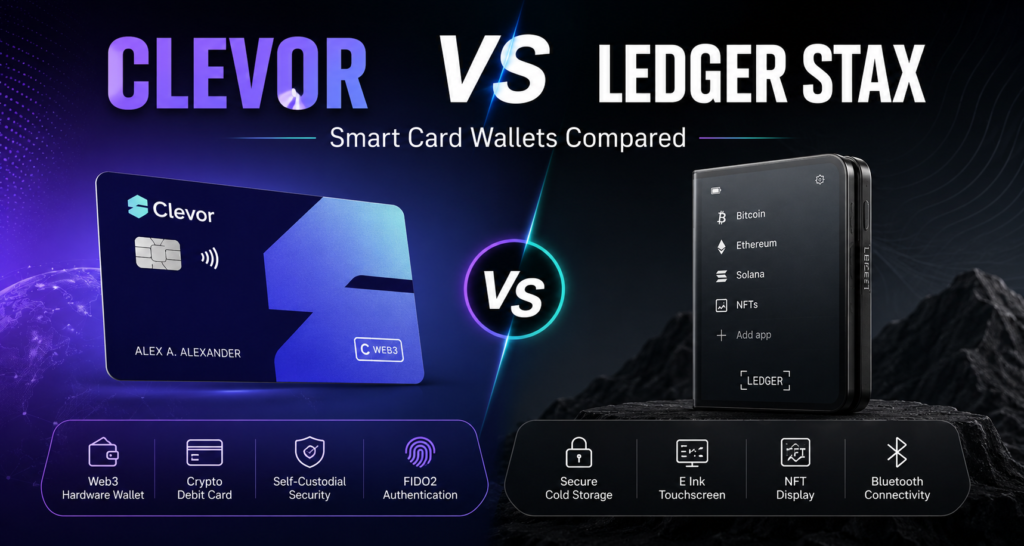
The crypto hardware wallet market is evolving fast. Traditional USB-style wallets are no longer the only option for securing digital assets. A new category is emerging — smart card crypto wallets that combine portability, payments, and Web3 access in a sleek card-sized format.
Two names attracting attention in this segment are Ledger Ledger Stax and Clevor Card. While both focus on crypto security and user convenience, their approach is very different.
Ledger Stax emphasizes premium hardware wallet functionality with a modern touchscreen design. Clevor positions itself as an all-in-one Web3 hardware wallet and crypto debit card that bridges traditional finance and decentralized finance together.
If you are choosing between these two devices, this comparison will help you understand which one fits your crypto lifestyle better.
What Is Ledger Stax?
Ledger Stax Ledger Stax is a premium hardware wallet developed by Ledger in collaboration with iPod creator Tony Fadell. It features a curved E Ink touchscreen, Bluetooth support, wireless charging, and NFT display functionality.
The device is designed primarily for secure crypto storage and transaction signing. It supports thousands of cryptocurrencies and integrates with the Ledger Live ecosystem.
Ledger Stax is ideal for users who want:
- Advanced cold storage security
- NFT management
- Large asset support
- Premium design and display
- Wireless usability
However, Ledger Stax mainly focuses on asset storage and transaction approval rather than real-world crypto spending.
What Is Clevor Card?
Clevor Card Clevor is a next-generation crypto smartcard designed to combine multiple financial technologies into one physical card. According to the company material, the card integrates:
- Web3 hardware wallet functionality
- Crypto debit card capabilities
- FIDO2 authentication
- Self-custodial security
- Crypto-to-fiat payment support
The card is designed to work as a portable Web3 banking solution where users can securely manage assets, authorize transactions, and make crypto payments globally.
Unlike traditional hardware wallets, Clevor focuses heavily on usability and daily financial transactions.
Design Comparison
Ledger Stax
Ledger Stax looks like a compact premium gadget. Its curved E Ink display gives it a futuristic appearance, and the magnetic stacking system adds a luxury feel.
Key Design Features
- Curved touchscreen
- Wireless charging
- Bluetooth connectivity
- NFT lock screen display
- Premium build quality
The design is impressive, but it is still bulkier than a standard payment card.
Clevor Card
Clevor takes a completely different approach. It is designed as a crypto smartcard that resembles a traditional bank card. The focus is portability and practical usage.
Key Design Features
- Slim smart card format
- NFC-enabled interactions
- Debit card functionality
- Plug-and-play usability
- Traditional wallet compatibility
The portability factor makes it easier for daily carry and real-world usage.
Security Comparison
Security is the most important aspect of any crypto wallet.
Ledger Stax Security
Ledger has built a strong reputation in hardware wallet security. Ledger Stax includes:
- Secure Element chip
- Offline private key storage
- Clear-sign transaction verification
- PIN protection
- Recovery phrase backup
However, Ledger wallets still rely heavily on seed phrase management.
Clevor Security
Clevor introduces a different security philosophy. According to the product overview, private keys never leave the card, and the platform includes cryptographic replacement technology.
The company highlights several security advantages:
Self-Custodial Wallet Card
Users retain full ownership of their assets without depending on centralized exchanges.
No Key Backup Required
One standout feature is the card replacement mechanism that reportedly allows wallet continuity without manual seed phrase backup.
Banking-Grade Security
The card includes encrypted infrastructure and tamper-resistant technology.
FIDO2 Authentication
Clevor also supports passwordless authentication for online services.
For users worried about losing seed phrases, this could be a major differentiator.
Web3 Functionality
Ledger Stax
Ledger integrates with:
- DeFi platforms
- NFT marketplaces
- Web3 dApps
- Ledger Live ecosystem
It is excellent for advanced crypto users who interact frequently with blockchain ecosystems.
Clevor
Clevor is positioning itself directly as a Web3 hardware wallet built for seamless real-world interactions.
According to the company presentation, users can:
- Sign on-chain transactions
- Conduct stablecoin payments
- Use DeFi applications
- Access TradFi and DeFi together
- Perform crypto-to-fiat top-ups
The company refers to the product as “a Web3 bank in the palm of your hand.”
This makes Clevor appealing for users who want a practical Web3 finance solution rather than only asset storage.
Crypto Payment Capabilities
This is where the biggest difference appears.
Ledger Stax
Ledger Stax itself is not a crypto debit card. While Ledger partners with payment providers through Ledger Live, the wallet is primarily a storage device.
Users often need third-party integrations to spend crypto in real-world environments.
Clevor Crypto Debit Card Features
Clevor strongly emphasizes payment functionality.
Crypto Debit Card
The card supports crypto-to-fiat conversion for purchases and point-of-sale payments.
Mastercard/Visa Compatibility
The product overview mentions compatibility with traditional payment rails powered by Mastercard or Visa.
Stablecoin Transactions
Users can reportedly conduct instant self-custodied stablecoin payments globally.
Real-World Spending
The system is designed to bridge crypto and traditional banking infrastructure.
For users seeking a crypto debit card combined with secure self-custody, Clevor offers a more integrated approach.
User Experience
Ledger Stax UX
Ledger Stax provides:
- Premium app ecosystem
- Smooth touchscreen interface
- Wireless convenience
- Established software infrastructure
However, it may still feel like a device designed primarily for crypto-native users.
Clevor UX
Clevor appears focused on simplifying Web3 adoption.
Key usability highlights include:
- Plug-and-play setup
- Card-style familiarity
- Instant payment usability
- Simplified crypto management
- Reduced dependency on complex backups
The goal seems to be mainstream adoption through simplicity.
Feature Comparison Table
| Feature | Clevor Card | Ledger Stax |
| Form Factor | Smart card | Hardware wallet device |
| Web3 Hardware Wallet | Yes | Yes |
| Crypto Debit Card | Yes | Limited/Indirect |
| Self-Custodial Wallet Card | Yes | Yes |
| FIDO2 Authentication | Yes | No |
| Touchscreen | No large display | Curved E Ink display |
| NFT Display | Limited | Yes |
| Crypto-to-Fiat Payments | Built-in focus | Third-party integrations |
| Seed Phrase Dependency | Reduced approach | Required |
| DeFi Integration | Yes | Yes |
| Portability | Very high | Medium |
| Daily Spending Focus | Strong | Moderate |
Which Wallet Is Better?
The better option depends entirely on your usage style.
Choose Ledger Stax If:
- You prioritize premium hardware wallet design
- You actively manage NFTs
- You want an established ecosystem
- You prefer advanced cold storage
- You are comfortable with seed phrase management
Choose Clevor If:
- You want a Web3 hardware wallet for daily use
- You need crypto debit card functionality
- You prefer a self-custodial wallet card
- You want simple crypto payments
- You value portability and ease of use
- You want TradFi and DeFi integration in one card
Final Verdict
Ledger Stax and Clevor represent two different visions of crypto finance.
Ledger Stax focuses on premium asset security and ecosystem integration for experienced crypto holders. It is a sophisticated cold storage device with modern aesthetics.
Clevor, on the other hand, is trying to redefine how crypto fits into everyday financial life. By combining a crypto smartcard, Web3 hardware wallet, self-custodial wallet card, and crypto debit card into one solution, it aims to make blockchain finance practical for mainstream users.
As Web3 adoption grows, the future may shift toward devices that combine secure self-custody with real-world usability — and that is exactly the space where Clevor is positioning itself.