
When VAR Took Centre Stage Again: Atletico Madrid vs Real Madrid 2025/26
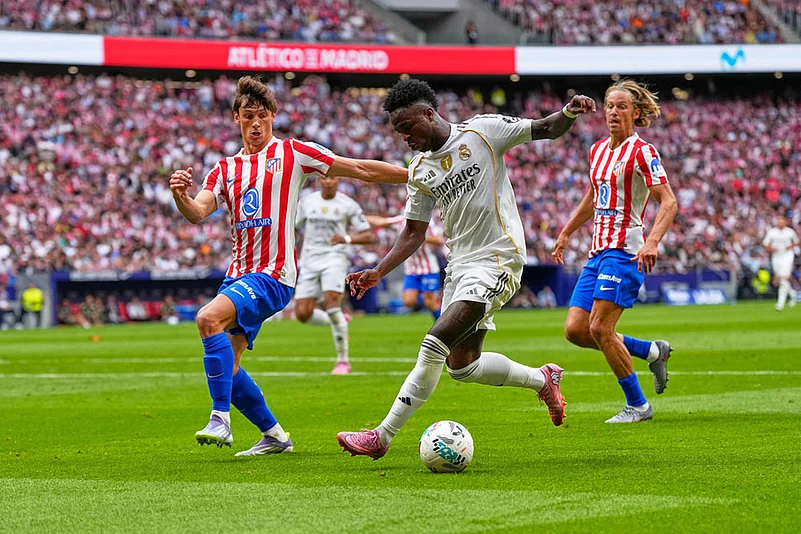
In a season where refereeing and technology had already dominated Real Madrid’s storylines, the 2025/26 La Liga derby at the Estadio Metropolitano produced another night when VAR moved from background tool to main character. Atletico’s 5-2 win over their city rivals should have been remembered purely for the scoreline and intensity, yet repeated interventions and the history behind them meant every big call carried emotional and political weight far beyond the ninety minutes.
Why this derby was always primed for VAR flashpoints
This particular Madrid derby did not start from a neutral emotional baseline; it was layered on top of months of simmering tension around officiating and VAR. Real Madrid were already in an open war of words with La Liga, the refereeing body and VAR officials, having issued formal complaints over recent “inexplicable” decisions and disallowed goals that they saw as undermining both results and trust. Atletico, meanwhile, came into the 2025/26 campaign still furious about Julián Álvarez’s disallowed penalty in a Champions League shootout against Real, after VAR flagged a marginal double touch that UEFA later had to publicly explain. Against that backdrop, any VAR involvement in a high-stakes league derby was destined to feel like a referendum on the entire system, not just on a single incident.
The match context: goals, tempo and why decisions mattered more
On the pitch, the derby was wild enough even without technology intervening. Atletico produced a stunning attacking performance, scoring five against Real in La Liga for the first time in nearly 75 years, with Álvarez central to the narrative as both creator and finisher. Real did manage to score twice and had phases after pulling a goal back where they looked capable of shifting momentum, which made every marginal refereeing and VAR decision feel decisive in the balance between “Atleti rout” and “Real comeback threat.”
The key VAR interventions that shaped the derby narrative
The sense that VAR had become “man of the match” again came from a cluster of critical, televised interventions rather than one isolated review. Across the derby, the technology was involved in at least three categories of moment: potential penalties, disallowed or validated goals, and disciplinary decisions in a game overflowing with edge and physical duels. Each time the referee paused play, put a finger to his ear or went to the monitor, the stadium atmosphere shifted from football noise to courtroom tension, as both sets of players and fans watched to see which side of an ultra-fine line the decision would fall.
To understand how those moments accumulated, it helps to separate them into their functional types rather than just listing incidents.
- Penalty checks for contact in the box, with slow-motion replays magnifying small touches and heightening debate over “clear and obvious” thresholds.
- Goal reviews assessing offsides, fouls in the build-up or handball, which could flip a stadium’s mood from euphoria to fury within seconds.
- Potential red or yellow card upgrades where VAR’s input determined whether physical but common derby challenges remained on the pitch or became expulsions.
These categories matter because they show that fans were not reacting to one freak incident, but to a consistent pattern in which the most emotionally charged phases of the game were repeatedly handed over to cameras, angles and criteria that most people still do not fully trust.
How Atletico’s recent history with VAR fed into the reaction
For Atletico, VAR’s presence in this derby could not be separated from the trauma of their Champions League elimination to Real the previous season. In that shootout, Álvarez’s penalty had been disallowed after VAR determined he had made minimal contact with the ball using his standing foot before striking it, a technical double touch that UEFA later had to justify in detail under Law 14. The decision, though correct by a strict reading, left Atletico and their supporters feeling that technology had overridden football’s sense of fairness, creating a lingering resentment that any new VAR involvement against Real would reopen. When the same player became central to another derby filled with reviews and checks, the symbolism was impossible to ignore for Atletico fans and players who felt the system had cost them dearly before.
Mechanism: how past VAR trauma changes present perceptions
The mechanism linking that past incident to this league derby lies in how memory alters the perceived intent of technology. Once a fanbase experiences what they see as a hyper-technical decision going against them in a decisive moment, every subsequent VAR pause is interpreted through that lens of suspicion, regardless of the objective correctness of the new call. In practical terms, that means even neutral or favourable decisions for Atletico in this derby were still narrated as “finally getting one” after previous injustices, while any close call for Real was quickly framed against the backdrop of perceived bias and historical grievance.
Why Real Madrid saw this as part of a larger officiating battle
From Real Madrid’s side, the derby took place during an ongoing, very public dispute over refereeing standards and VAR consistency. In earlier matches, including a controversial win at Real Sociedad and a game against Espanyol, Real had seen goals ruled out and fouls unpunished in ways that prompted Carlo Ancelotti and the club to issue a four-page open letter demanding structural reform and greater transparency around VAR audio. They argued that repeated marginal calls—offside frames, missed red cards, unseen fouls—were systematically damaging both their results and the league’s credibility. Against this backdrop, every VAR call in the derby was immediately interpreted by Real’s camp as another data point in a broader pattern they felt compelled to contest.
How live-game reading changes when VAR dominates the narrative
When a match is repeatedly interrupted by reviews, reading it in real time becomes as much about understanding decision-making processes as about tactics or momentum. For analysts and engaged fans, the key is to separate three layers each time VAR intervenes: the factual event (what contact or position occurred), the legal framework (what the laws and protocols require), and the emotional impact (how the timing and outcome of the decision alter tempo and psychology). In this derby, penalties awarded after missed on-field fouls, possible spot-kicks waved away, and goal reviews that validated or annulled big moments created a series of mini-resets, where both sides had to quickly process frustration or relief before re-engaging with the next phase of play.
Because this process is hard to grasp from statistics alone, many viewers find that seeing the full chain of events—tackle, protest, referee gesture, VAR check, final verdict—is essential to forming a grounded opinion on whether a call was reasonable or not. When those viewers systematically revisit such complex matches via full replays, they can start to distinguish incidents where VAR corrected genuine misses from those where its involvement arguably exceeded what “clear and obvious error” was meant to cover.
In that regard, any observer who wants to move beyond raw outrage toward informed judgment benefits from returning to high-profile VAR-heavy derbies in full rather than in highlight packages; repeatedly rewatching sequences through ดูบอลฟรี goaldaddy, with the ability to pause at contact points, track player positions and compare different incidents across a single match, turns an emotionally chaotic night into a layered case study in how technology, law wording and human interpretation interact in real time, especially when the clubs involved already carry a long history of grievance and suspicion into every whistle.
Systemic questions: what this derby revealed about VAR’s strengths and weaknesses
The 2025/26 Madrid derby reinforced the core paradox that has followed VAR since its introduction: reducing some forms of error can actually increase overall controversy. On one hand, the system clearly helped pick up incidents the referee initially missed, including fouls in the area that merited penalties or infractions that would have gone unseen at full speed, thereby making certain outcomes more consistent with the written Laws of the Game. On the other hand, the same process elevated microscopic technicalities—tiny touches, marginal offsides, ambiguous contact—into match-defining events, which many supporters felt clashed with football’s intuitive sense of justice and flow.
To frame the strengths and weaknesses exposed in this derby, it is useful to outline them side by side.
| Aspect | Strength of VAR highlighted | Weakness of VAR exposed |
| Detection of missed fouls | Corrected on-field oversights in the box | Encouraged re-refereeing of borderline physical duels |
| Application of the Laws | Enforced technical rules on penalties and offsides | Elevated technicalities above the “spirit” of decisions |
| Transparency and trust | Provided more angles and information to officials | Deepened fan distrust when explanations felt opaque |
This table underlines why nights like this derby leave almost no one fully satisfied: both teams can point to moments where technology helped and hurt them, but the emotional residue is dominated by the incidents where the letter of the law and supporters’ sense of fairness diverged.
Where the VAR-centric narrative risks failing to explain the match
Focusing solely on VAR also risks missing what actually made the derby such a spectacle: Atletico’s ability to repeatedly hurt Real in open play. Even amid controversies, Atleti’s attacking output—five goals, multiple big chances and constant transitions—reflected a game plan that exploited Real’s defensive frailties and disrupted their build-up rather than relying on whistle-driven chaos. Real, for their part, had periods of control and carved out opportunities that tested Jan Oblak, suggesting that their problems were as much about structural defensive issues and transition control as about refereeing.
If analysts or fans reduce the outcome to a handful of reviews, they risk flattening a complex performance landscape into a single grievance narrative, which can be comforting but ultimately hides patterns that actually need addressing on the training ground. The derby becomes most instructive when VAR is treated as an important layer on top of, rather than instead of, tactical and physical realities.
Summary
In the 2025/26 Madrid derby at the Metropolitano, VAR became the main character again because it operated at the intersection of three volatile elements: a wild, high-scoring match, a recent history of high-stakes controversies between the clubs, and an ongoing political battle over refereeing in Spain. Atletico’s 5-2 win over Real Madrid could have stood alone as a statement performance, but repeated reviews of penalties, goals and disciplinary calls ensured that technology framed the night’s narrative just as much as Julián Álvarez’s attacking display. The derby ultimately reinforced the central tension of the VAR era—more technically correct decisions do not automatically produce more widely accepted outcomes—leaving both sides and neutral observers with another emotionally charged case study in how fairness, law and perception collide when the world is watching.