
Cross-Entropy Loss: Loss Function Measuring the Performance of Classification Models
In the field of machine learning, classification models are designed so that inputs are assigned to particular categories. For example, a model can be used to predict if an email is spam or not, if a customer will churn, or whether an image shows a cat or a dog. In order to improve these models, we need a method for assessing how good or how bad their predictions are, and it is in this context that cross-entropy loss becomes important.
Cross-entropy loss is one of the most commonly used loss functions when dealing with classification problems since it allows for the measurement of the difference between the probabilities that a model predicts and the true class labels. Rather than just determining if a prediction is correct or not, it assesses how confident the model is in its prediction and whether that level of confidence is warranted. For people who are studying these ideas as part of a data science course in Kolkata, it is important to understand cross-entropy loss because it provides a practical link between mathematics, probability, and the process of training a model.
What Is Cross-Entropy Loss?
Cross-entropy loss is a function employed to assess the performance of classification models, in particular when the output consists of a probability value between 0 and 1; it is frequently used in logistic regression, in neural networks, and in classification tasks involving deep learning.
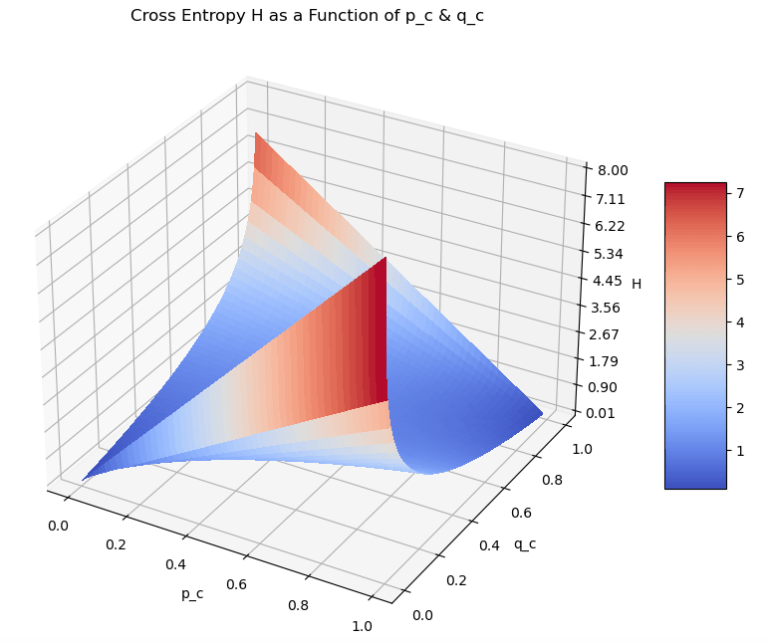
The fundamental idea is simple: a classification model outputs probabilities for one or more classes. In the case where the true class is 1, the probability that the model assigns to that class should be nearly 1; and when the true class is 0, the probability it assigns should be close to 0. The cross-entropy loss imposes a heavier penalty on the model when it assigns a high probability to the incorrect class.
For binary classification, the loss depends on two things:
- The actual label
- The predicted probability
When the value predicted by the model is near the true label, the loss is small; but when the predicted value is far from the actual one, the loss becomes large. This is why cross-entropy is useful since it causes the model to become both accurate and confident in the correct direction.
Why Cross-Entropy Loss Matters in Classification
An accuracy figure by itself doesn’t usually give the whole picture since two models can have the same accuracy yet very different confidence levels. For instance, one model might assign a probability of 0.51 to a positive class while another does so with a probability of 0.95; both cases would be regarded as correct if the threshold is 0.5. Nevertheless, the second model demonstrates greater confidence. The cross-entropy loss reflects this difference.
It is important since machine learning models are trained by minimising loss rather than by directly maximising accuracy. While the model is being trained, the algorithm makes step-by-step adjustments to the weights in order to reduce the loss value. A well-designed loss function leads the model to make better predictions.
Cross-entropy loss is especially useful because:
It penalises wrong and overconfident predictions strongly
When a model is very confident about a wrong class the loss increases considerably. As a result the model is made to alter this behaviour during training.
It works well with probability-based outputs
Because many classification models provide probabilities, cross-entropy fits easily into the learning process.
It supports gradient-based optimisation
Methods such as gradient descent make use of smooth mathematical functions, and cross-entropy offers a good basis for optimisation, which in turn helps the model to learn efficiently.
It is therefore a standard subject in any serious data science course taught in Kolkata which includes supervised learning and neural networks.
Cross-Entropy Loss in Binary and Multi-Class Problems
Cross-entropy loss is applicable to both binary and multi-class classification.
Binary classification
In the case of binary classification the model gives one probability, this probability indicating the chance that the input belongs to the positive class. Examples are fraud detection, disease prediction and spam filtering.
When the correct answer is 1 and the model gives a prediction of 0.95, the loss is very small; but if the prediction is 0.10 then the loss is high since the model has been far from the true label.
Multi-class classification
In the case of multi-class classification, the model produces a probability distribution over a number of classes. For instance, an image classifier might give out probabilities for cat, dog, horse, and bird. The class which is correct should have the highest probability; cross-entropy loss compares the entire predicted distribution with the true class and imposes a penalty on the model when the correct class has a low probability.
That is why cross-entropy is usually used in conjunction with the softmax function in neural networks: because softmax transforms the raw scores into probabilities and then cross-entropy measures how close those probabilities are to the true labels.
A Practical Example of How It Works
Picture a model which categorises customer reviews as positive or negative.
Suppose the true label is positive:
- Model A has a probability of 0.90 for predicting a positive outcome.
- Model B has a probability of 0.55 for predicting positively.
- Model C has a probability of 0.05 for predicting positively.
Each of the three models gives a prediction, but the quality of these predictions is not the same. Model A is both right and confident, which is why its loss is very small. Model B is correct yet uncertain, leading to a moderate loss. As for Model C, it is incorrect and at the same time very confident in the wrong direction, resulting in a high loss.
The fact that it does so makes cross-entropy a very practical choice; it doesn’t merely reward accuracy, it also rewards accurate confidence and penalises inaccurate confidence. This feature is important in real-world systems in which the certainty of a prediction is relevant, for example in healthcare, finance and recommendation engines.
Examples such as this are helpful for students in Kolkata studying a course in data science as they enable the concept to move from theory to practice.
Common Challenges in Understanding Cross-Entropy Loss
Cross-entropy is difficult for a lot of beginners since it involves both probability and logarithms; but the concept is simpler when you see it as a system for assessing the quality of a probability.
Some common points of confusion include:
Loss is not the same as error count
A model may have a higher loss even if it makes fewer mistakes provided that it is too confident when it is wrong.
Lower loss means better probability estimates
It’s not merely a question of setting the class correctly, it’s also about assigning reasonable probabilities.
Logarithms increase penalties for bad predictions
It is the logarithmic character of the formula that results in wrong predictions being given heavy penalties.
After one has grasped these ideas, cross-entropy is much easier to understand when the system is being trained and when it is being evaluated.
Conclusion
Cross-entropy loss is so important in the area of classification modelling since it shows how closely the predicted probabilities agree with the true labels; it is not just about simple correctness and instead helps in training models that are accurate, reliable and better calibrated. It plays a central role in modern ML workflows regardless of whether the problem is binary or multi-class.
A solid understanding of cross-entropy loss helps learners build stronger foundations in classification, neural networks, and optimisation. It is one of those concepts that may look mathematical at first, but once understood, it explains a great deal about how intelligent systems learn from data.